SAP Enterprise AI Gateway vs. Multi-Cloud AI Gateway: An Architectural Comparison
With the announcement of the new SAP Enterprise AI Gateway, SAP is setting a clear milestone for the operational use of artificial intelligence in enterprises. For SAP users and enterprise architects, this announcement sends a twofold message: On the one hand, SAP confirms that central AI gateways have become indispensable as a control layer for safely managing the transition from isolated AI pilots to autonomous, agent-based AI systems. On the other hand, BTP users now have a native way to orchestrate and secure AI models, agents, and tools directly within the SAP ecosystem. According to SAP, general availability is planned for the first quarter of 2027.
But what does this step specifically mean for your AI and cloud strategy?
While the SAP Enterprise AI Gateway is precisely tailored to processes in S/4HANA, SAP SuccessFactors, and SAP Joule, many IT decision-makers are faced with a fundamental question: Is a platform-specific gateway sufficient if their own IT landscape also relies on AWS, Microsoft Azure, or Google Cloud? This article analyzes the implications of SAP’s announcement and objectively compares the SAP Enterprise AI Gateway with a vendor-neutral multi-cloud AI gateway (PCG).
What is the difference between the SAP Enterprise AI Gateway and a multi-cloud AI gateway?
The SAP Enterprise AI Gateway is a vertical extension of the SAP Integration Suite for the native management of AI models in SAP S/4HANA and Joule. A vendor-neutral multi-cloud AI gateway acts as a horizontal control layer within the organization’s own cloud tenant (AWS, Azure, GCP) to orchestrate enterprise-wide FinOps budgeting, model diversity, and non-SAP workloads without vendor lock-in.
What can the SAP Enterprise AI Gateway do
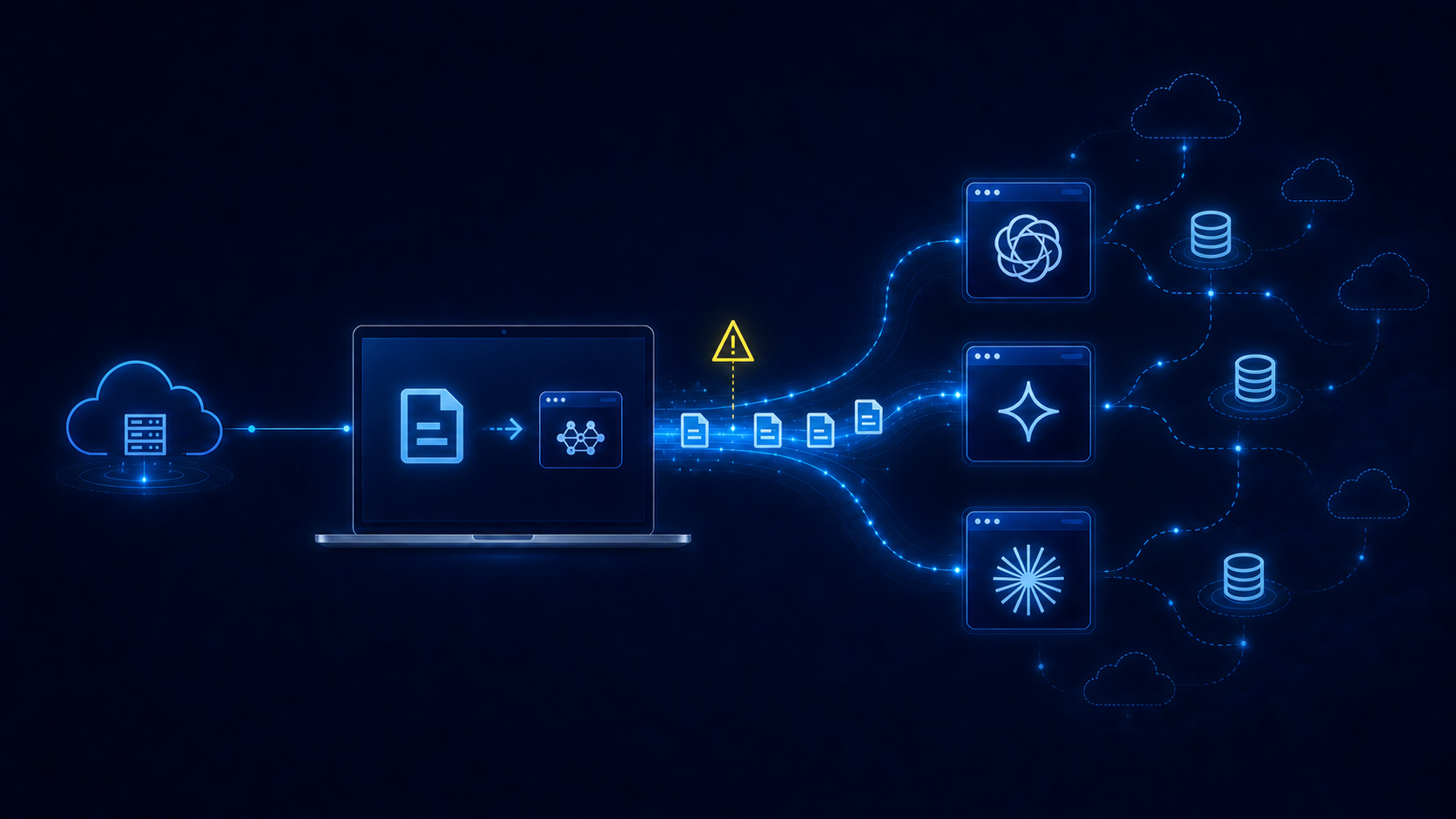
At SAP TechEd, SAP introduced the SAP Enterprise AI Gateway—a premium offering based on the SAP Integration Suite and the SAP Business AI Platform. The gateway addresses the challenge that agent-based AI introduces new interaction patterns and potential sources of error into existing enterprise integration. Instead of creating an isolated interface for each AI application, the SAP Enterprise AI Gateway extends the established integration foundation with a unified policy and control layer.
The system supports four key interaction patterns without forcing them into a rigid technical framework:
- Agent-to-Agent (A2A): Enables direct orchestration and collaboration between different AI agents.
- Model Context Protocol (MCP): Provides a standardized mechanism through which agents can dynamically identify and invoke enterprise tools and business capabilities.
- Model Interfaces: Standardizes application access to various large language models (LLMs).
- Enterprise APIs: Integrates existing APIs and integration paths where the actual business logic is executed.
The key strength of the SAP AI Gateway lies in its seamless integration within the BTP ecosystem. Companies do not need to rebuild their existing integration landscape.
A verified agent or an MCP tool can be approved in the SAP AI Agent Hub and then specifically deployed for authorized processes. In addition, the gateway offers integrated guardrails: Sensitive customer data such as names, addresses, or payment references in customer orders is automatically masked before the request is forwarded to an external AI model.
For companies whose core business processes are built entirely on SAP S/4HANA, SAP SuccessFactors, and SAP Joule, the SAP Enterprise AI Gateway offers consistent management of identities, access permissions, and data flows directly at the point of process execution.
Limitations of Platform-Native Gateways in Hybrid Multi-Cloud Scenarios
As significant as SAP’s announcement is for the BTP ecosystem, a purely platform-native gateway encounters natural limitations as soon as an enterprise’s IT infrastructure extends beyond the SAP ecosystem. In practice, modern IT landscapes are almost without exception heterogeneous and distribute their workloads across various cloud providers.
Typical limitations of platform-native gateways in multi-cloud scenarios include:
- Model access only through the platform provider: SAP offers a broad model portfolio via the Generative AI Hub, including OpenAI models via Azure, Anthropic Claude via AWS Bedrock, Gemini via Vertex AI, as well as Mistral and open-source models. However, access is provided through SAP’s contracts, quotas, and BTP regions, not through the company’s own hyperscaler accounts. This limits the ability to utilize existing commitments with AWS, Microsoft, or Google, as well as the company’s own fine-tunings or models that SAP does not (yet) offer. Furthermore, not every model is available in every BTP region.
- Isolated data and application sources: While custom applications, proprietary B2B platforms, in-house microservices, or non-SAP databases can be integrated via generic APIs, they do not benefit from the native governance mechanisms of the SAP ecosystem.
- Fragmented FinOps and token budgeting: The SAP gateway is designed to provide usage and cost tracking as well as rate limits, but only for traffic that runs through the BTP. If AI queries in marketing applications on AWS, developer pipelines on Azure, or support bots on GCP run via their own interfaces, cost control becomes fragmented. Enterprise-wide, centralized token budgeting cannot be implemented this way.
- Risk of vendor lock-in for inference costs: If the application and AI governance are rigidly tied to a single platform, switching to more cost-effective or higher-performance models from other providers becomes technically complex and economically unattractive.
How to connect AI agents to your SAP
Key Components of the PCG AI Gateway in Detail
The PCG Multi-Cloud AI Gateway not only differs from the SAP Enterprise AI Gateway in its vendor-neutral approach but, as a standalone platform, also offers an expanded range of features for modern development and AI scenarios:
- Integrated MCP Gateway: Seamless orchestration and provisioning of tools and enterprise contexts via the Model Context Protocol (MCP) across various cloud environments.
- Direct integration for coding harnesses: Development teams can directly integrate existing coding assistants and developer tools and manage them centrally.
- Platform instead of a simple proxy: Comprehensive management of knowledge sources, standalone agents, tools, and specific skills instead of simple traffic proxying.
- EU-hosted Open-Weight Models & Cost Control: In addition to leading frontier models, EU-hosted Open-Weight models are supported to both comply with data protection requirements and specifically optimize inference costs.
SAP BTP vs. Vendor-Neutral Multi-Cloud Gateway
The fundamental difference between the two approaches lies in the architecture’s layered model: While the SAP Enterprise AI Gateway is designed as a vertical extension of the SAP Integration Suite, the PCG AI Gateway functions as a vendor-neutral, horizontal control and operations layer (a LiteLLM-based proxy) that is installed and managed directly within the customer’s own cloud accounts (AWS, Azure, or GCP).
The following comparison table directly contrasts the architectural parameters and feature sets of both gateway concepts.
| Architecture Dimension | SAP Enterprise AI Gateway (BTP) | PCG Multi-Cloud AI Gateway |
|---|---|---|
|
Deployment Location & Data Residency |
SAP Business Technology Platform (BTP) |
Customer’s own cloud tenant (AWS, Azure, GCP / Cloud Run, Cloud SQL) |
|
Platform & Model Access |
Broad portfolio via Generative AI Hub (e.g. OpenAI, Anthropic, Gemini, Mistral), provided through SAP contracts and BTP regions |
All leading models (AWS Bedrock, Azure OpenAI, Vertex AI, Anthropic, Open Source) |
|
Process & Data Integration |
Deep native integration into SAP S/4HANA, SuccessFactors, Joule |
Seamless connection of non-SAP data, custom apps, VPCs & CI/CD pipelines |
|
Cost & Budget Control (FinOps) |
BTP-related usage and consumption transparency |
Enterprise-wide budgeting, active complexity routing across platforms |
|
Pricing Model & Licensing |
BTP consumption model / Premium Suite option – conditions not yet public |
Flat fee + use case component (no per-seat user licenses) |
|
Operating & Support Model |
SAP Platform Management / Standard BTP Support |
Fully Managed Operations (Managed Service 8×5/24×7, SecOps, audit trails, SLAs) |
|
Sovereignty & Lock-in Protection |
High BTP standardization, lock-in to SAP ecosystem |
Maximum model and hyperscaler independence, full data sovereignty |
FinOps, Latency, and Model Diversity
When strategically evaluating an AI gateway, IT decision-makers should place particular emphasis on three core factors, as these directly determine the economic scalability and future viability of AI initiatives.
- Model Diversity and Avoiding Vendor Lock-in: The pace of innovation in the model market is extremely fast. A model that leads today in terms of reasoning capabilities may be surpassed tomorrow by a competitor in terms of inference costs. The PCG AI Gateway completely decouples the application logic from the specific AI provider. Through a unified API interface, developers can swap out or combine models from AWS Bedrock, Azure OpenAI, or Google Vertex AI without modifying application code.The SAP AI Gateway also provides model access but is primarily optimized for securely deploying models within SAP business processes.
- Enterprise-wide FinOps and Token Budgeting: With the rollout of AI agents, there is a risk of shifting from usage-based inference costs to budgets that are difficult to control. If hundreds of teams use AI services independently, costs could spiral out of control without centralized FinOps. The PCG AI Gateway implements a centralized cost dashboard with active budgeting: Token limits & quotas: Allocation of transparent monthly or project budgets per department or use case. Intelligent complexity routing: Automatic routing of simple prompts to cost-effective models and of complex queries to high-end LLMs. Predictable operating costs: The pricing model is based on a transparent flat operating fee rather than per-user license fees, as is common with many SaaS AI platforms.
- Custom Governance and Tailored Architectures: While the SAP AI Gateway secures existing enterprise APIs and MCP interfaces in the BTP context and masks sensitive data, the PCG AI Gateway excels in tailored enterprise architectures. Since the proxy runs directly within the customer’s own Virtual Private Cloud (VPC) network, it offers maximum flexibility in implementing custom governance policies. Companies benefit from customized RAG (Retrieval-Augmented Generation) pipelines as well as specialized security and SIEM integrations without platform-specific limitations.
Coexistence Instead of an Either/Or Choice
The question of which AI Gateway is right cannot be answered with a decision in favor of a single product. Rather, the choice depends on the IT infrastructure and the primary use case.
When the SAP AI Gateway is the right choice:
- Pure SAP environments: When your company is strategically and fully standardized on the SAP Business Technology Platform (BTP) as its central core.
- Focus on SAP core processes: When the primary use case involves the direct extension of S/4HANA, SAP SuccessFactors, or the use of SAP Joule.
- Existing BTP teams: When your development and operations teams are already working extensively with the SAP Integration Suite and the SAP AI Agent Hub.
When the vendor-neutral multi-cloud AI Gateway (PCG) is the better choice:
- True multi-cloud infrastructures: When your company runs workloads in parallel on AWS, Microsoft Azure, and Google Cloud and wants to flexibly combine models from AWS Bedrock, Azure OpenAI, and Vertex AI.
- Integration of non-SAP applications: When custom applications, proprietary data sources, developer pipelines, and external partner systems need to be connected.
- Centralized FinOps & Budgeting: When you need global, cross-departmental cost management to prevent inference costs from spiraling out of control.
- Avoiding Vendor Lock-in: When you aim for maximum data sovereignty within your own cloud tenant and complete independence from individual model providers.
The Strategic Recommendation: The Hybrid Model
In practice, the two systems are by no means mutually exclusive. For large enterprises, the coexistence of both gateways often proves to be the ideal solution: The SAP Enterprise AI Gateway handles highly specialized, process-oriented control and data masking within the BTP and S/4HANA environments.
The PCG AI Gateway functions as a higher-level, vendor-neutral multi-cloud control layer for the entire enterprise. It manages central model access, regulates global FinOps budgeting, and secures custom applications. This allows companies to leverage the strengths of both worlds—maximum process integration with complete strategic freedom.
FAQ
Continue reading